
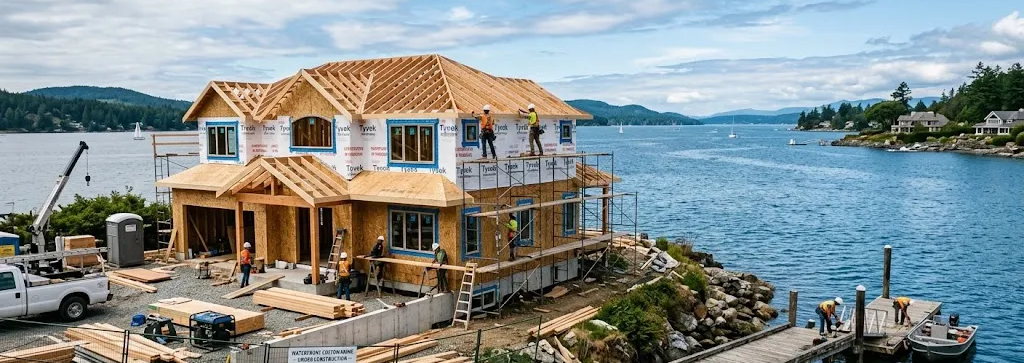
Waterfront Home Building & Renovation in Southern Maryland
Critical Area Experts · Flood Zone Design · Chesapeake Bay & Patuxent River Properties
Building or renovating a home on the Chesapeake Bay, the Patuxent River, or one of Southern Maryland's many creeks and coves is unlike any other construction project. The views are extraordinary. The lifestyle is unmatched. And the regulatory and engineering requirements are unlike anything you'll encounter on an inland property.
Maryland's Chesapeake Bay Critical Area law, FEMA flood zone requirements, tidal wetland setbacks, native vegetation buffers, living shoreline regulations, and Calvert and St. Mary's County permitting requirements all intersect on a waterfront lot — and navigating all of them simultaneously requires a contractor who knows this landscape intimately.
Chris Turner Home Improvements has been building and renovating waterfront homes in Southern Maryland since 1993. We've worked on properties along the Bay Cliffs in Calvert County, on the creeks and coves off the Patuxent, and on the St. Mary's County shoreline along the Potomac. If you own waterfront land and want to build or improve a home on it, we know exactly what the process involves — and how to move it forward efficiently.
Why Waterfront Construction Is Different
On a standard inland lot, a builder's primary concerns are setbacks, soils, and the county building code. On a Southern Maryland waterfront property, the regulatory environment is substantially more complex, and the physical conditions are more demanding. Here's what makes waterfront projects different — and why experience matters:
Multiple Permitting Layers
A waterfront project in Calvert County may require a county building permit, a Maryland Critical Area Commission review, a Maryland Department of the Environment (MDE) tidal wetlands permit, an Army Corps of Engineers (USACE) Section 404 permit for any work in waters of the US, and a Stormwater Management permit — all before construction begins. Each agency has its own timeline and requirements.
Longer Permitting Timelines
Waterfront projects in the Critical Area routinely take 4 to 9 months to permit — compared to 6 to 10 weeks for a standard county permit. Understanding this timeline and planning for it is essential. Contractors who haven't done this before routinely underestimate how long permitting takes, which leads to frustrated clients and broken project schedules.
Engineered Foundation Requirements
Most waterfront homes in Southern Maryland require elevated foundations — either a crawl space with an elevated slab, concrete piers, or driven pilings — to meet FEMA base flood elevation requirements and protect against storm surge and tidal flooding. Standard slab-on-grade construction is rarely appropriate for Bay-adjacent properties.
Coastal Material Requirements
Salt air, high humidity, UV exposure, and periodic flooding demand materials that simply don't apply inland. The wrong siding, decking, fasteners, or insulation on a waterfront property can fail in a fraction of the time it would on an inland home. Getting material selection right from the start is not optional.
The Chesapeake Bay Critical Area — What Every Waterfront Property Owner Needs to Know
Maryland's Chesapeake Bay Critical Area Act designates a 1,000-foot buffer from the mean high water line of tidal waters and tidal wetlands as a "Critical Area." Nearly every waterfront property on the Bay, the Patuxent River, and their tidal tributaries in Calvert and St. Mary's counties falls within this zone. Properties within the Critical Area are subject to regulations that go well beyond standard county building codes.
Critical Area Classifications
The Critical Area is divided into three zones, each with different rules:
- Intensely Developed Area (IDA) — existing developed areas, generally with some flexibility for infill construction and renovation
- Limited Development Area (LDA) — partially developed areas; significant restrictions on new impervious surfaces and clearing
- Resource Conservation Area (RCA) — the most restrictive classification; minimal new development permitted; applies to much of the undeveloped waterfront in Calvert and St. Mary's counties
What the Critical Area regulates
- Lot coverage — the total percentage of a lot that can be covered by impervious surfaces (roofs, driveways, patios, decks). Additions and new construction must stay within your lot's coverage limits.
- Setbacks from the water — most Critical Area properties require structures to be set back a minimum of 100 feet from the mean high water line, with some exceptions for existing non-conforming lots
- Native vegetation buffer — a mandatory 100-foot native plant buffer must be maintained (or restored) between any structure and the water; clearing within this buffer is heavily restricted
- Clearing and grading — removal of trees and vegetation within the Critical Area requires a Forest Conservation Plan and Critical Area clearing permit
- Stormwater management — all development must include stormwater management to prevent increased runoff into the Bay or its tributaries
CRITICAL AREA TIP
Many waterfront property owners are surprised to learn that adding a deck, a detached garage, or even a gravel driveway can push them over their lot coverage limit and trigger Critical Area review. Before planning any project on a waterfront lot, call us to assess your current coverage and how much room you have to work with. This assessment is part of our estimate process.
FEMA Flood Zones & Elevated Construction
Most waterfront properties in Calvert and St. Mary's County fall within FEMA-designated Special Flood Hazard Areas — primarily AE zones (river and bay flooding) and, for Bay-front properties, VE zones (coastal wave action). Building in these zones requires:
- Elevation certificates — a licensed surveyor must certify the Base Flood Elevation (BFE) on your lot before design begins; the BFE determines how high your finished floor must be elevated
- Elevated foundation design — the lowest floor of any habitable space must be at or above the BFE, typically 1 to 3 feet above, depending on county freeboard requirements and your flood insurance goals
- Flood-vented foundation walls — any enclosed space below the BFE must have flood vents that allow water to flow through without building pressure against foundation walls
- No mechanical equipment below BFE — HVAC equipment, electrical panels, and other critical systems must be elevated above the BFE
- Flood-resistant materials below BFE — any materials used below the base flood elevation must be rated for wet flood-proofing
The foundation and elevation decisions you make during design have a direct and lasting impact on your annual flood insurance premiums — often thousands of dollars per year. Building one foot above the minimum required elevation can reduce flood insurance costs significantly over the life of the home. We help clients understand these trade-offs during the design phase so they can make informed decisions.
VE ZONE
WARNING
Bayfront properties in Calvert County's VE (Velocity/Wave Action) zones face the most stringent requirements. VE zone construction requires open foundation systems — typically driven pilings — that allow wave energy to pass beneath the structure without destroying the foundation. Slab foundations and stem walls are not permitted in VE zones. We have experience designing and building piling-foundation homes for Bay-front properties.
FEMA Flood Zones & Elevated Construction
Most waterfront properties in Calvert and St. Mary's County fall within FEMA-designated Special Flood Hazard Areas — primarily AE zones (river and bay flooding) and, for Bay-front properties, VE zones (coastal wave action). Building in these zones requires:
- Elevation certificates — a licensed surveyor must certify the Base Flood Elevation (BFE) on your lot before design begins; the BFE determines how high your finished floor must be elevated
- Elevated foundation design — the lowest floor of any habitable space must be at or above the BFE, typically 1 to 3 feet above, depending on county freeboard requirements and your flood insurance goals
- Flood-vented foundation walls — any enclosed space below the BFE must have flood vents that allow water to flow through without building pressure against foundation walls
- No mechanical equipment below BFE — HVAC equipment, electrical panels, and other critical systems must be elevated above the BFE
- Flood-resistant materials below BFE — any materials used below the base flood elevation must be rated for wet flood-proofing
The foundation and elevation decisions you make during design have a direct and lasting impact on your annual flood insurance premiums — often thousands of dollars per year. Building one foot above the minimum required elevation can reduce flood insurance costs significantly over the life of the home. We help clients understand these trade-offs during the design phase so they can make informed decisions.
Building Materials for Waterfront Southern Maryland
Choosing the right materials for a waterfront home in Southern Maryland is not simply about aesthetics — it's about building something that survives the environment for decades rather than years. Here's how we approach material selection for waterfront projects:
Exterior Siding
Fiber cement siding (James Hardie Hardie Zone 10 products, specified for high-humidity coastal environments) is our first recommendation for Bay-adjacent homes. It does not absorb moisture, resists salt air, holds paint significantly longer than wood, and is warranted for coastal applications. High-grade vinyl is also appropriate. Wood siding, while beautiful, requires intensive maintenance in Southern Maryland's waterfront conditions and is not recommended for primary cladding on water-facing elevations.
Decking and Outdoor Structures
Open-joint composite decking (Trex, TimberTech, or Fiberon) is strongly recommended over pressure-treated wood for primary deck surfaces at waterfront properties. Composite resists the mold growth that thrives in our humid climate and won't splinter or check the way wood does under repeated wet-dry cycles. For structural framing below the deck surface, hot-dip galvanized or stainless steel hardware is mandatory — standard zinc-coated fasteners corrode rapidly within sight of salt water.
Windows and Doors
Water-facing windows and doors on Chesapeake Bay properties are subjected to wind-driven rain, salt spray, and UV exposure that inland products aren't designed for. We specify impact-rated or storm-rated glazing for water-facing elevations, stainless hardware for exterior door hardware, and fiberglass or aluminum door frames rather than wood on water-facing entries.
Foundation and Structural Elements
Concrete in tidal or near-tidal environments requires higher cement content and proper mix design to resist chloride penetration and carbonation. For piling foundations, we use concrete pilings or pressure-treated timber pilings treated to appropriate retention levels for marine exposure. All metal connectors and fasteners in the structural assembly use hot-dip galvanized or stainless steel.
Insulation
Closed-cell spray polyurethane foam is the preferred insulation for waterfront homes in Southern Maryland — it acts as both an air barrier and a vapor retarder, resists moisture intrusion, and adds structural rigidity to wall panels. This is particularly important in homes that may experience periodic flooding below the living level.
What We Build on Waterfront Properties
Chris Turner Home Improvements handles every type of construction project on waterfront lots in Calvert and St. Mary's County:
- Custom new home construction — build from the ground up on your waterfront lot, from site assessment through final walkthrough
- Demolish and rebuild — tear down an existing waterfront structure and replace it with a properly elevated, code-compliant new home
- Major whole-home renovation — gut and reconfigure an existing waterfront home to modernize the layout, improve views, and bring it up to current codes
- Additions — add a sunroom, screened porch, great room, or bedroom addition that takes advantage of your water views
- Deck and outdoor living construction — build or replace decks, porches, and covered outdoor spaces properly rated for coastal conditions
- Exterior remodeling — replace deteriorating siding, windows, and trim on an existing waterfront home with materials engineered for coastal exposure
- Elevated foundation retrofits — in some cases, we can assist with elevating existing structures to meet current flood zone requirements and reduce flood insurance costs
A Note on Shorelines: Maryland's Living Shoreline Policy
If your waterfront property has an eroding shoreline, you may be considering a hardened solution — a bulkhead, seawall, or riprap revetment. Maryland's policy, and the preference of the Critical Area Commission and MDE, now strongly favors living shorelines — planted marsh grass, oyster reef structures, and bio-rolls that stabilize the shoreline naturally while providing habitat and improving water quality.
While we don't design or install living shoreline systems ourselves, we can refer you to licensed shoreline consultants and coordinate construction activities to protect any restoration work in progress. For any project near the water's edge, we also take care to meet all Maryland erosion and sediment control requirements during construction — protecting your shoreline and neighbors' properties throughout the build.
Our Waterfront Construction Process
Waterfront construction can also demand more upfront planning than conventional construction — laying down the regulatory and engineering groundwork before building anything saves a huge amount of time and money later.
1
Site assessment & feasibility review. We evaluate your lot's Critical Area classification, flood zone designation, current lot coverage, setbacks, elevation certificate status, and any recorded easements or deed restrictions. This shapes every decision that follows.
2
Pre-application meeting (if needed). For complex projects or first-time waterfront builders, we recommend a pre-application meeting with Calvert or St. Mary's County planning staff and, where applicable, Critical Area Commission staff to discuss the project before formal applications are submitted.
3
Design & engineering. We work with your architect and structural engineer to develop plans that meet Critical Area standards, FEMA flood zone requirements, and county building code — coordinated from the start to avoid redesigns during permit review.
4
Permit applications. We prepare and submit all required applications: county building permit, Critical Area permit, MDE tidal wetlands permit where required, stormwater management plan, and forest conservation plan where applicable.
5
Agency review & response. We monitor application status, respond to agency requests for additional information, and attend required review meetings on your behalf. This phase requires patience — and experience in how each agency operates.
6
Construction. With all permits in hand, we manage every phase of construction: site preparation and erosion controls, foundation, framing, systems rough-in, exterior, and interior finish — with required inspections at each stage.
7
Final inspection, elevation certificate & closeout. After construction, a final elevation certificate is prepared by a licensed surveyor confirming the as-built finished floor elevation. This document is critical for your flood insurance policy.
Building or renovating a home on the Chesapeake Bay, the Patuxent River, or one of Southern Maryland's many creeks and coves is unlike any other construction project. The views are extraordinary. The lifestyle is unmatched. And the regulatory and engineering requirements are unlike anything you'll encounter on an inland property.
Maryland’s Chesapeake Bay Critical Area law, FEMA flood zone requirements, tidal wetland setbacks, native vegetation buffers, living shoreline regulations, and Calvert and St. Mary’s County permitting requirements all overlap on a waterfront lot — and navigating all at once requires a contractor with a deep knowledge of this landscape.
Chris Turner Home Improvements has been building and renovating waterfront homes in Southern Maryland since 1993. We’ve built along the Bay Cliffs of Calvert County, along the creeks and coves off the Patuxent, and on the St. Mary’s County shoreline along the Potomac. If you have waterfront land to build or improve a home on, we know exactly what the process entails — and how to carry it forward quickly.
How Waterfront Construction Is Different
On a typical inland lot, a builder’s top concerns are setbacks, soils, and the county building code. On a waterfront property in Southern Maryland, the regulatory framework is far more sophisticated and the physical conditions correspondingly more arduous. This is what makes waterfront projects special — and why experience matters:
Frequently Asked Questions
Can I build a new home within the Chesapeake Bay Critical Area?
Yes — but the scope of what's permitted depends on your property's Critical Area classification (IDA, LDA, or RCA), current lot coverage, and setback situation. Properties in Intensely Developed Areas have more flexibility. Resource Conservation Areas are the most restrictive. In all cases, new construction must comply with Critical Area standards for setbacks, lot coverage, native vegetation buffers, and stormwater management. Chris Turner will assess your specific lot's allowances during the free estimate..
How far from the water do I have to build in Calvert County?
The standard Critical Area setback is 100 feet from the mean high water line of tidal waters and tidal wetlands. Some older, non-conforming lots may have reduced setback requirements based on pre-existing conditions. Additional setbacks may apply for steep slopes, unstable soils (such as the Calvert Cliffs formation), and certain tidal wetland types. Your lot's specific setback must be confirmed during site assessment — don't assume it matches a neighbor's property.
What type of foundation is required for a waterfront home in Southern Maryland?
It depends on your flood zone designation and site conditions. In AE flood zones, an elevated crawl space or stem wall with flood vents is typically used, raising the finished floor to or above the Base Flood Elevation. In VE zones (coastal wave action areas common on Bay-front properties in Calvert County), open piling foundations are required — the structure must be elevated on pilings that allow wave energy to pass through without structural damage. Chris Turner works with engineers to design foundations appropriate for your specific site and flood zone.
How long does it take to permit a new waterfront home in Calvert County?
Plan for 4 to 9 months for permitting on a new waterfront home in the Critical Area, depending on project complexity and the agencies involved. A straightforward renovation on an already-developed lot in an IDA may permit in 3 to 4 months. A new home on an undeveloped lot in an LDA or RCA, requiring Critical Area Commission review, MDE tidal wetlands permits, and a forest conservation plan, can take 6 to 9 months or longer. We set realistic expectations on the timeline from the very beginning.
Will building higher above the flood elevation reduce my flood insurance costs?
Yes, significantly. NFIP flood insurance premiums are directly tied to the difference between your finished floor elevation and the Base Flood Elevation — the more elevation above BFE, the lower your annual premium. Building one foot above the minimum required elevation can reduce annual premiums by 25–40%; two feet above can reduce them by 40–60% or more. We walk clients through the cost-benefit analysis during the design phase so the elevation decision is made with full information about long-term insurance cost implications.
Do I need to restore a native vegetation buffer on my waterfront property?
If your property is within the Critical Area and the native vegetation buffer between your structures and the water has been cleared or degraded, buffer restoration may be required as a condition of any new development permit. Maryland's Critical Area law requires a 100-foot native plant buffer from tidal waters. Restoration plans must use approved native species and are reviewed by the county's Critical Area planner. We coordinate with qualified landscape consultants for buffer restoration plans when required.
Can you renovate an existing waterfront home that was built before Critical Area regulations?
Yes. Many older waterfront homes in Calvert and St. Mary's counties predate the 1984 Critical Area law and have legal non-conforming status — they exist closer to the water or with more lot coverage than current regulations would allow for new construction. Renovation of these homes is generally permitted as long as the project doesn't increase the degree of non-conformity. We're experienced with non-conforming lot situations and will be upfront about what can and cannot be done on your specific property.
Ready to build on your waterfront property?
Call 410-414-8322 or contact us for a consultation.
Licensed MD contractor with Critical Area & Waterfront Construction experience.